


What Simpler Recycling rules mean for your wheelie bins
New Simpler Recycling regulations were introduced at the end of March 2025. These rules changed what UK businesses and most UK households can put in their wheelie bins and how they must separate specific waste materials.
Businesses that employ ten or more full-time staff should already have the correct Simpler Recycling bins in place to segregate dry recyclables, food waste, and non-recyclable rubbish.
What is Simpler Recycling?
Simpler Recycling is a UK government scheme to make household and workplace recycling more consistent across England. It aims to give residents, businesses, and employees more confidence about what they can throw away in each recycling bin, and to make the same rules apply at home and at work.
Simpler Recycling for households and businesses
The new Simpler Recycling legislation covers all businesses that generate waste "similar in nature and composition to household waste" and should – subject to local councils' transition arrangements – eventually cover all households in England too.
If you don't already have the correct Simpler Recycling bins in place, now is the time to make the change, so you can start to benefit from the national switch to an easier and more consistent system.
When does Simpler Recycling start?
There are three Simpler Recycling introduction dates to be aware of:
-
31 March 2025: Simpler Recycling starts for businesses with 10+ full-time employees.
-
31 March 2026: Simpler Recycling should be introduced for household kerbside collections.
-
31 March 2027: Simpler Recycling begins for businesses with fewer than 10 full-time employees.
These key Simpler Recycling dates can have quite a different significance depending on whether you’re a householder, business, or employee:
-
From 31 March 2026, local councils should offer weekly kerbside collections of food waste, meaning no more smelly bins in summer.
-
Household Simpler Recycling collections may be delayed (in some cases by over a decade) by local council transition arrangements and other issues.
-
Microbusinesses (including sole traders) account for 95% of UK businesses but only about 30% of the workforce.
Why are Simpler Recycling reforms being introduced?
In April 2025, the Local Government Association noted the need for the Simpler Recycling reforms, saying: "The UK government has set an ambitious target to recycle 65% of municipal waste by 2035. According to UK government waste statistics, household recycling rates in England have remained around 44-45% since 2015, falling to 43.3% in 2022-23."
Business waste is a particular concern, accounting for more than three-fifths of England's total waste in 2022 – 33.7 million tonnes, compared with 21.4 million tonnes from households.
Simpler Recycling legislation aims to recover more recyclable materials from businesses and homes across England and ensure higher-quality waste that’s recycled. For example, businesses must legally separate dry recyclables, such as paper, from wet waste, such as leftover food, to reduce cross-contamination and improve recycling rates.
Empty food packaging like metal cans, plastic bottles, and glass jars should be rinsed before being discarded, reducing potential pollutants in your recycling bins. Similar rules for households introduced from 31 March 2026 ensure that rubbish is recycled the same way at home and work.
Transitionary Simpler Recycling exemptions mean not all councils have fully made the change – and some might not do so for many years. Eventually, domestic food waste will be collected weekly across England, helping keep more organic waste out of landfill and reducing bad odours from your bins.
What is Simpler Recycling going to achieve?
There are several goals of Simpler Recycling in England:
-
Remove the postcode lottery for kerbside recycling collections
-
Reduce general waste and recyclable rubbish sent to landfill by homes and businesses
-
Increase overall recycling rates (and reduce contaminated loads)
All of this should have significant environmental benefits in England, where recycling rates have plateaued in recent years.
What types of waste are included?
Under the Simpler Recycling rules, businesses must use bins and separate waste into at least three different categories:
-
Dry recyclables
-
Paper and card
-
Glass
-
Plastic
-
Metal
-
Food waste
-
Kitchen waste
-
Leftover food
-
General waste
-
Residual waste
-
Unrecyclable packaging
-
Contaminated food packaging
-
Hygiene products (e.g. nappies)
Businesses should have at least three separate wheelie bins (or other suitable containers) for general waste, food, and dry mixed recycling.
Does Simpler Recycling include garden waste?
Depending on your business type and waste management contract terms, your provider may require you to have an additional bin for garden waste. You may also need a separate container to keep paper and card away from glass, paper, and metal.
From April 2026, Simpler Recycling rules should mean every household receives weekly food waste collections by their local council. While this aims to provide consistency across the country, the way these are carried out can vary. Some councils may collect food waste in household garden waste bins while others will provide a separate food caddy.
Are there any exemptions?
Simpler Recycling exemptions apply to some types of waste. In general, the Simpler Recycling requirements apply to recyclable and biodegradable materials, including all waste from the preparation of food, and to dry packaging such as paper, plastic, metal, and glass.
A few examples of Simpler Recycling exemptions include:
-
Hazardous containers (paint pots/cans and oil/antifreeze bottles)
-
Non-packaging glass (cookware, drinkware, window glass)
-
Sanitary waste (used nappies, feminine hygiene products)
-
Some composite plastics (polystyrene, garden furniture)
-
Treated paper (laminated, glitter, foil, and bubble wrap envelopes)
If a material isn’t suitable for any other type of Simpler Recycling bins, it should be discarded with general waste.
Will Simpler Recycling impact my business?
Simpler Recycling applies to all businesses. That means offices, educational facilities, charity shops, and also public-facing venues in hospitality and foodservice. The rules came into effect for firms with at least 10 full-time employees on 31 March 2025, and apply to microbusinesses from 31 March 2027.
It's worth noting that the Simpler Recycling rules are based on your total workforce across all locations. If you have two sites with five full-time employees each, you have a total of ten employees, so you should already be compliant.
Regardless of size, the Simpler Recycling scope expands in 2027, so ensure you have any new recycling bins you need to be fully compliant.
The good news is, complying with Simpler Recycling makes good sense for businesses anyway. The rules are a sensible way to separate your waste and, in many workplaces, will reduce the number of different coloured recycling bins you need overall.
What colour bins do I need for Simpler Recycling?
There are no official guidelines on the colour of recycling bins under the Simpler Recycling plans for England's households, businesses, and local authorities to follow.
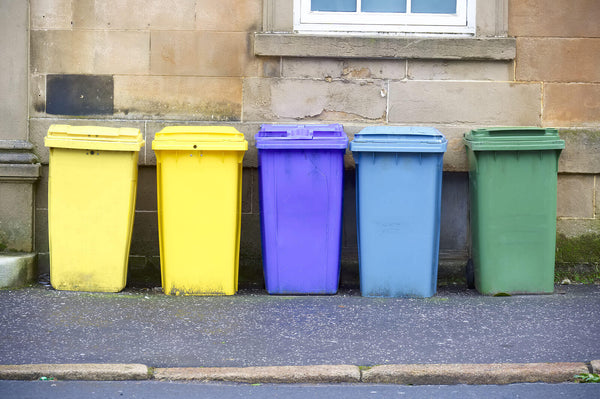
However, Defra's guidance refers to residual/general waste as "black bin waste". Paper and card are usually disposed of in a blue wheelie bin, while mixed dry recyclables (plastic, glass, and metal) may be in brown, red, or burgundy recycling bins, although this varies across regions and industries.
Simpler Recycling bins for garden waste
Green recycling bins are usually for garden waste, which your waste management provider may incorporate with food waste under the new rules. Whatever colours you use, it's a good idea to be consistent, and to consider labelling your recycling bins clearly with the kind of waste they store, to avoid any accidental contamination.
You should also ensure you have enough of each type of bin. Smaller wheelie bins are best for waste that must be taken a long way to reach its collection point, so it's easier and safer to move on bin day.
Simpler Recycling bins for food waste
Kitchen food waste caddies are a great way to collect vegetable peelings and plate scrapings in a convenient, colour-coded container, which you can carry out to the corresponding wheelie bin for outdoor disposal.
Are you ready for Simpler Recycling rules?
Follow these simple three steps to get ready to recycle and make sure you comply with the new Simpler Recycling rules for your business in England:
-
Identify the different types and quantities of waste you produce.
-
Speak to your waste management provider about the size and colour of recycling bins you need.
-
Contact Wheelie Bin Solutions to get new recycling bins in the correct colours and sizes.
We have commercial wheelie bins in sizes from 120 litres right up to 1,100-litre industrial wheelie bins, in ten different colours and a choice of plastic or metal – offering everything you need to get your recyclables organised under the new Simpler Recycling rules.



Wheelie Bin Solutions, Unit 15c, Yardley Road,
Liverpool L33 7SS
Company Number: 06116305. VAT Number: 902561744
© 2026 Wheelie Bin Solutions.


Craig Pryce
With over 17 years of experience in the waste and recycling industry, Craig is passionate about making recycling easier and reducing the negative impact of litter. He has been the managing director of Wheelie Bin Solutions (WBS) since January 2016, and prides the company on his expert knowledge, top-quality products, and customer service. His proudest moment was when WBS supported the 2012 Olympic Games, working in partnership with Contenur UK to supply over 9000 bin containers to all Olympic venues. Craig is always keen to share his knowledge, so whether you need advice about the benefits of a wheelie bin lock, or ideas for alternative uses for your wheelie bin, Craig will ensure your recycling and waste disposal habits are gold medal worthy.